Lace is not one article. Buyers who treat “lace” as a single SKU end up with the wrong weight, the wrong stretch and the wrong edge. For apparel, the useful split is by how the openwork is made, not by how it looks in a photo.
Embroidery lace
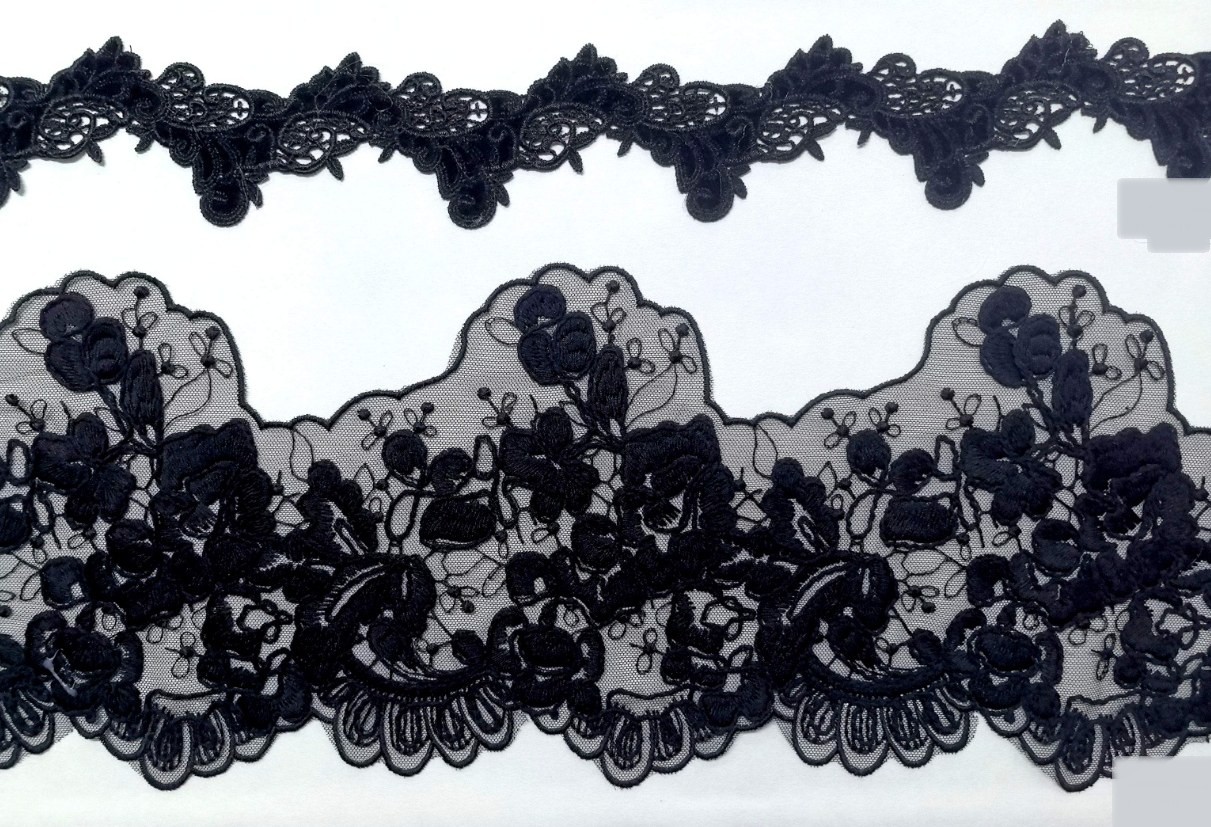
Embroidery lace is stitched onto a ground — tulle, organza, cotton lawn or a soluble nonwoven. The motif is built from thread, so it can look raised and “worked.” Typical embroidery yarns are cotton, viscose rayon, polyester filament, nylon and metallic. The ground adds bulk: a cotton-backed Schiffli can feel substantial on a neckline; a fine tulle ground stays lighter.
Hand embroidery still appears on couture and small-run bridal. Volume programs run on multi-head embroidery machines. The trade-off is familiar: rich relief, but snagging on the stitch surface and a higher cost per metre than warp-knit lace.
Chemical lace (soluble lace)
Chemical lace is embroidery whose ground is removed. Viscose or polyester is stitched onto a water-soluble nonwoven. After hot-water dissolution, only the embroidered motif remains — a true openwork with a clean edge and no residual mesh. The trade name “chemical lace” is historical; modern production is almost always aqueous, not acid-based.
It is favoured on lingerie, eveningwear and appliqué motifs because it sits softly on skin and has no bulky ground. It is also slower and more expensive than Raschel. Soft motifs can distort if they are pulled hard in sewing or washing, so pattern engineers usually keep connecting bars in the design.
Raschel (warp-knit) lace
Most fashion lace by volume is Raschel lace, made on multi-bar warp-knitting machines. A mesh ground is formed in the same pass as the motif. Nylon, polyester and elastane are the workhorse yarns. More guide bars give more independent motif movement; electronic jacquard and presser-plate (Textronic-type) machines can imitate a heavier, embroidered look while remaining a knit.
- Mechanical Raschel: pattern by chain links; slower pattern changes.
- Jacquardtronic-type Raschel: a more mobile ground and motif.
- Elastic Raschel (nylon/polyester + elastane): lingerie, bodywear, stretch galloons.
- Sized (stiffened) nylon Raschel: bridal veils and structured skirts.
Raschel is efficient, consistent and the right default for ready-to-wear. It is also flatter than embroidery lace. If a designer wants a heavy, carved edge, ask for a chemical-lace or guipure construction instead of forcing Raschel to impersonate it.
Other constructions buyers still meet
Leavers lace (Calais-Caudry in France still uses the protected indication Dentelle de Calais-Caudry) is made on Leavers machines descended from nineteenth-century Nottingham engineering. Thousands of warp and weft threads can be controlled independently. The cloth is fine, expensive and produced in short runs.
Torchon and crochet-look galloons are made on lace-braiding or crochet machines — useful for home textiles and folk-inspired apparel, with a more three-dimensional cord.
Woven jacquard lace is a true woven, denser than a knit, with a firmer hand.
| Construction | Typical end use | What to watch |
|---|---|---|
| Raschel galloon | dresses, lingerie, RTW | stretch %, scallop repeat, edge quality |
| Chemical / guipure motif | bridal, lingerie, appliqué | connecting bars, wash stability |
| Embroidery on tulle | evening, kidswear | snagging, ground show-through |
| Leavers | heritage bridal | price, lead time, metre availability |
When you send a spec to Guangzhou, name the construction, the fibre, the width, the scallop repeat and whether the lace must match a stretch fabric. A pretty swatch without those fields is not a trim spec.