Fashion lace is a warp-knit, embroidery or Leavers product with a geography. China is one of the world’s large producers. The useful buyer map is by cluster and construction, not by a single “lace factory in the south.”
Clusters
Shantou (Guangdong) is widely described as a complete warp-knit lace base: yarn, knitting, dyeing, finishing, export. If you are buying elastic galloons and lingerie Raschel at volume, you will meet this supply.
Changle (Fujian) is the other large warp-knit and chemical-fibre lace story, including mills that have moved onto shared digital-order platforms. Polyester and nylon Raschel for ready-to-wear sit here in bulk.
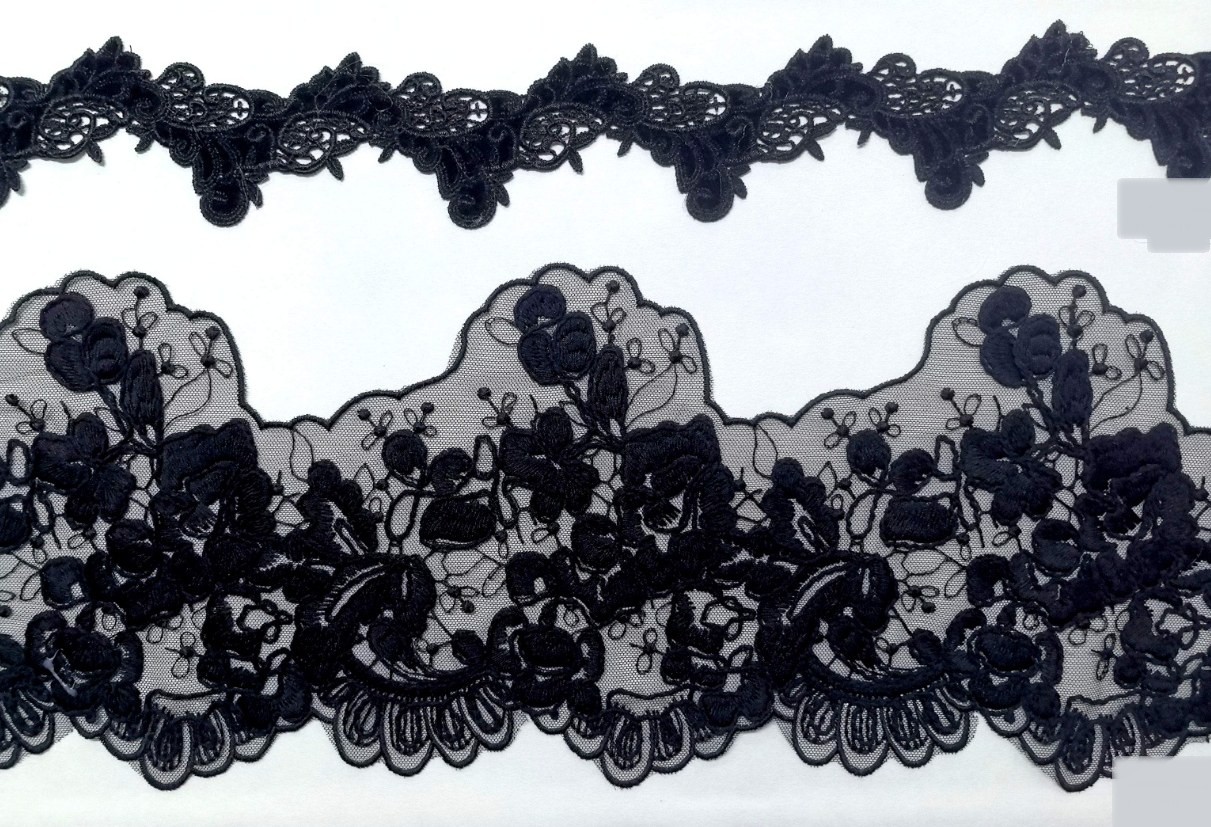
Chaozhou (Guangdong) is the name bridal and heavier decorative lace buyers still use — embroidery, chemical (soluble) lace, and the show-piece motifs that do not belong on a 12-bar mechanical Raschel.
Zhejiang (Yiwu and neighbours) trades narrower laces, braids and mixed trims in the small-lot, many-SKU style of that market.
France (Calais-Caudry Leavers) remains a short-run, high-price reference. It is not a substitute mill for a Guangzhou RTW programme.
What to test besides the pretty repeat
Chinese product language for warp-knit lace centres on FZ/T 63045. Buyers still add textile methods: wash and perspiration colour fastness (GB/T 3921, related ISO 105), rubbing (GB/T 3920), sometimes light. Kids’ chemical limits follow GB 31701 and the brand RSL (formaldehyde, pH, phthalates on coated or printed lace). Export EU programmes add REACH (including azo-cleavable dyes). US colour-fastness talk often cites AATCC wash methods.
Physical mill checks that prevent chargebacks: motif consistency, width tolerance, hole uniformity, broken ends, snags, oil. Filament Raschel snags are the classic customer complaint; density, finish and a snag method (trade cites GB/T 11047) are the conversation, not a softer adjective on the quote.
Elastic lace needs a recovery figure, not only a stretch percentage. A pretty scallop that grows 8 mm after sewing is a pattern problem.
How we sample from Guangzhou
Name construction (Raschel, chemical, embroidery), fibre, width, scallop repeat, stretch, and the dye standard. A swatch without those fields is a postcard.
Export paths are ordinary: B2B platforms, Intertextile-type fairs, and brand-nominated mills. EU lots still pick up REACH (including azo) and, on kidswear with cords in the same garment, EN 14682 — that last one is a garment cord rule, not a lace rule, but buyers mix them on one lab form. US lots often add AATCC wash fastness language. None of that replaces FZ/T 63045 as the Chinese product spec for warp-knit lace.
Lead time follows the machine, not the city. A mechanical Raschel recut is a bar-and-chain job; an embroidery or chemical-lace motif is a digitising and dissolve job. Changle volume and Chaozhou bridal can both ship late if the dyehouse is the bottleneck. Put the dye mill on the BOM when colour is the risk.
TrimGem’s lace notes stay on construction and mill geography. We do not treat “Chaozhou” as a quality grade by itself.