Some shirts want a mineral face: cold, hard, glossy, not quite plastic and not quite mother-of-pearl. Ceramic, glass and stone buttons occupy that niche. They are sew-ons. They are brittle in a way metal is not. They should not be specified as “crystal” unless they actually are.
Ceramic
Trade “ceramic buttons” split into two factories.
Ordinary porcelain is sintered, glazed, decorated, often set on a metal shank or back. Colour and gloss are excellent; mechanical toughness is only as good as the glaze and the firing. Runs are smaller than urea resin.
Zirconia (zirconium dioxide) is pressed and sintered to a much higher toughness. Mills sell it as a hard, wear-resistant shirt button — sometimes as “unbreakable,” which is marketing. It still chips if you drop a bulk carton on concrete. It is non-magnetic and does not conduct at room temperature, which helps some metal-detection and harsh-chemistry stories. Sweat does not etch it the way it etches a cheap plate.
Shapes follow the usual round, plus hearts and polygons for fashion. Holes are one to four. Shirt sizes sit small and close; coat sizes sit larger and more spaced.
Glass, “crystal” and stone
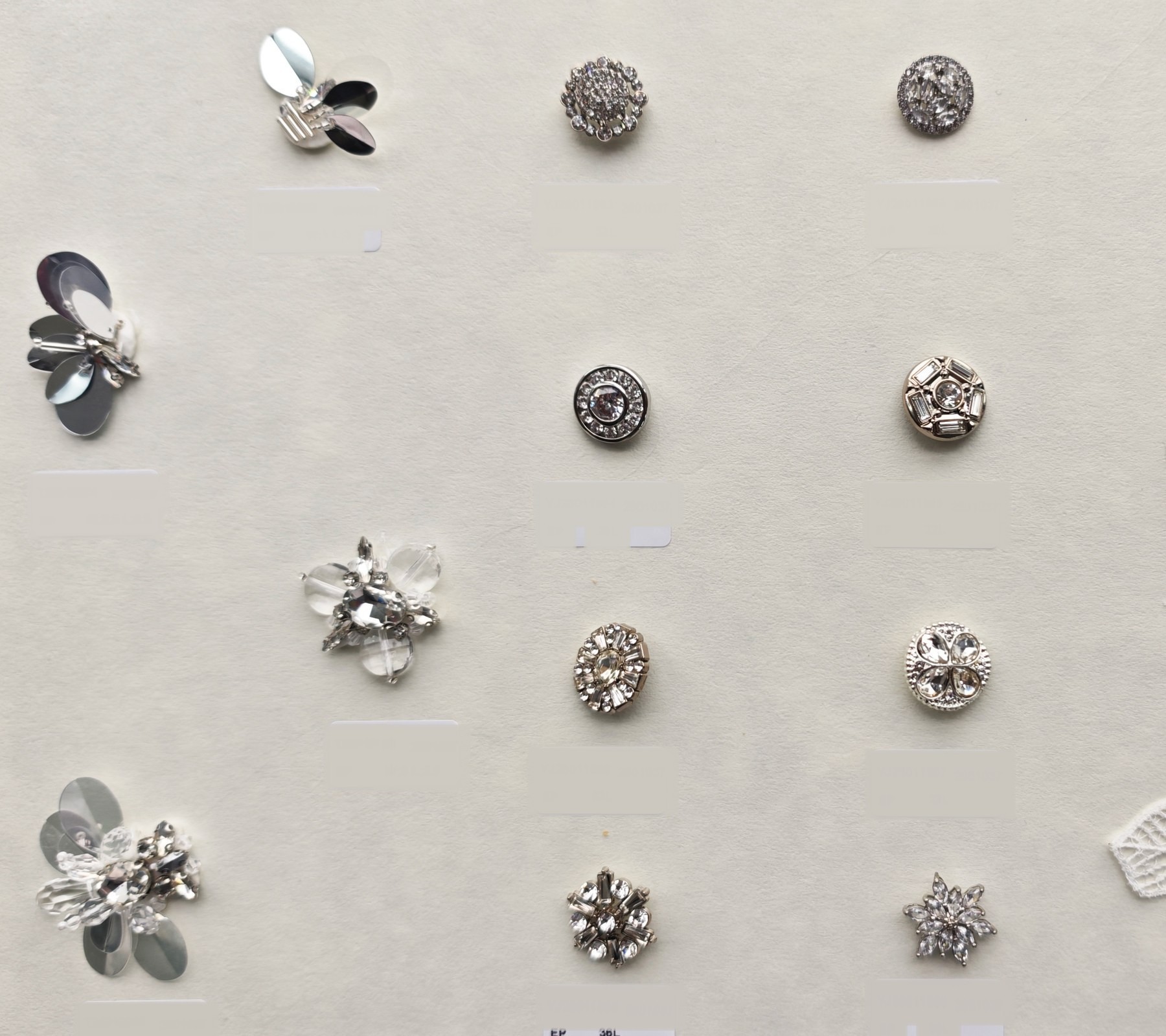
Glass pearl buttons with a wavy pearlescent layer are a known shirt article — brighter than a flat pearl resin, more “cat’s-eye” than a printed urea. Man-made crystal (lead glass or similar jewellery glass, depending on the mill) is a decorative sew-on, not a gemmological diamond. Real gemstone buttons are rare; low-grade stone and marble-look discs are the volume “stone” story, hard and solvent-resistant, used when a natural veining is the point.
Do not confuse these with Manhattan-type pearlescent resin buttons (heat-pressed imitations of shell). Those belong on the resin card.
What fails in production
Ceramic and glass hate shock and point loads. Sewing machines need the right foot and hole chamfer. Metal backs must be seated so the ceramic does not take the clamp load. Laser and pad-print logos are extra processes after polish; they need their own rub and wash checks.
Kidswear: hardness does not cancel small-parts and sharpness rules. A beautiful 10 mm crystal sew-on on an infant garment is still a small part.
Laser logos on ceramic are a later process, after polish. Early mechanical engraving was crude; fine laser marks are now the brand-initial route on shirt programmes. They still need a rub check — a mark that is only a surface tint will fade before the zirconia does.
Ordinary glazed porcelain with a metal back is a jewellery construction: the ceramic face can be beautiful and the back can rust or nickel-release. Spec the back as metal hardware, not as “ceramic.” Stone discs with natural veining are lot-variable; approve a range, not one hero button.
Wash and dry-clean are usually kind to mineral faces; impact is not. Pack them so they do not rattle against each other in the carton.
TrimGem samples ceramic and glass as a material family with a drop-and-sew check, not as “fancy resin.”