
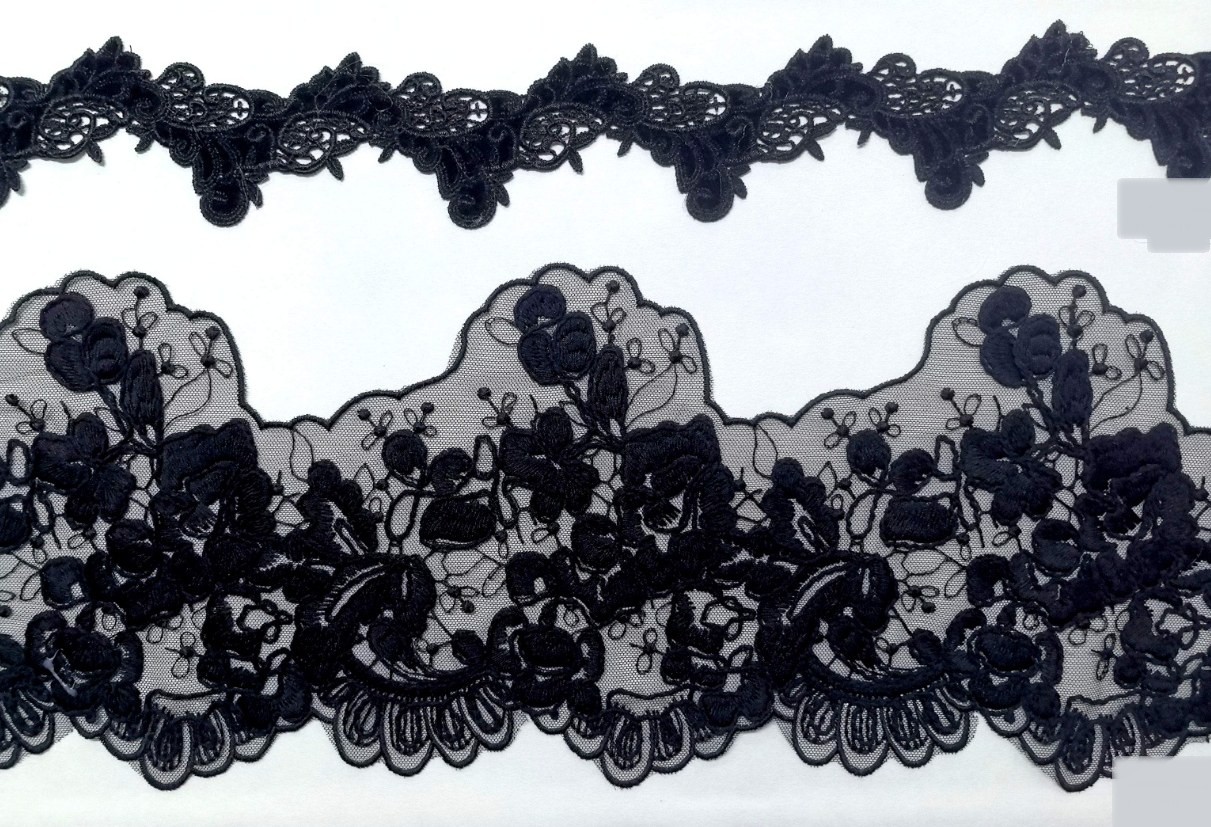
Buyers often receive two swatches that look similar in a flat-lay and behave nothing like each other in a sewing room. One is chemical lace (soluble embroidery). The other is Raschel lace. Choosing the wrong one shows up as growth in washing, a hard scallop, or a price that cannot survive a 3,000-piece run.
What each machine is actually doing
Raschel lace is a warp knit. Needles form a mesh and inlay yarns draw the motif in the same fabric. The lace has a knitted structure you can feel: a slight give even without elastane, and a mesh that remains after washing.
Chemical lace is embroidery plus dissolution. The motif is stitched onto a soluble nonwoven, usually with viscose or polyester. After the ground is washed out, there is no mesh — only the embroidered bars and picots. That is why a good chemical lace looks “cut from air” and why a weak one falls apart at the first hard pull.
Guipure is a related idea: a motif held by bars, with no net ground. Some guipure is embroidered/soluble; some is Raschel designed to look like guipure. Do not assume the word “guipure” tells you the machine.
Hand, drape and sewing
Chemical lace is usually softer against skin and more dimensional. It is the better match for lingerie, appliqués and bridal motifs that sit on tulle. Because there is no knit ground, it does not recover like an elastic Raschel. Pattern pieces should not be stretched over a knee or a bust without a stable backing.
Raschel is flatter, more regular and easier to sew in long runs. Elastic Raschel (nylon or polyester with elastane) is the correct family for stretch bodywear. Rigid, slightly sized Raschel is still the workhorse for bridal overlays that must hold a veil shape.
In the sewing room, Raschel edges can be overlocked or left as a finished scallop. Chemical-lace motifs often need to be appliquéd or inserted; a raw embroidered bar will snag if it is expected to behave like a knit galloon.
Cost and MOQ logic
Raschel wins on metre price and on repeatability. Pattern changes cost time on mechanical machines; electronic jacquard has narrowed that gap. Chemical lace pays for embroidery time and for the dissolve/dry line. Small motifs (collars, sleeve insertions) can still be economical. All-over chemical lace for a full skirt rarely is, unless the brand is pricing bridal.
If a designer wants “that couture look” at a mid-market cost, a Textronic-type Raschel (presser-plate warp knit that mimics embroidery relief) is often the honest compromise. It will not match a fine Calais Leavers, and it should not be sold as one.
Spec both laces the same way: fibre content, width, scallop repeat, stretch (if any), colour method (piece-dye vs yarn-dye), and a wash test against the shell fabric. Construction is not a mood board word.